Move Over, Hero: Why We're Finally Ready to Watch Our Favorites Become the Sidekick
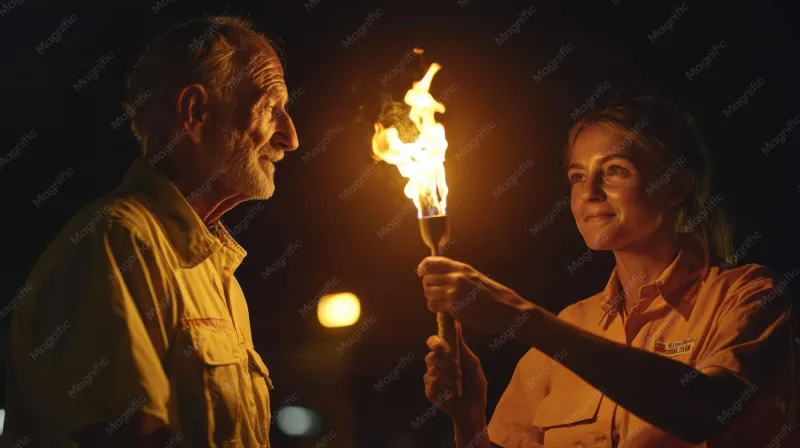
Photo: mentor passing torch to younger person cinematic dramatic lighting, via img.freepik.com
There's a scene in Spider-Man: Into the Spider-Verse where Peter B. Parker — pudgy, burned-out, emotionally checked out — shows up as the guy who's supposed to inspire Miles Morales. He's not inspiring. He's a mess. He eats cold pizza and doesn't want to be there. And somehow, that's exactly what makes it work.
That version of Peter isn't the hero anymore. He's the reluctant guide, the cautionary tale, the man who's already lived the myth and is standing in its wreckage. Miles has to become Spider-Man without Peter saving the day. And audiences didn't just accept that — they lost their minds over it. Into the Spider-Verse became one of the most celebrated animated films in a generation, not despite sidelining its legacy character, but because of it.
Something is changing in how we relate to our fictional heroes. And it's worth sitting with that for a minute.
The Nostalgia Trap Franchises Used to Fall Into
For a long time, the entertainment industry operated on a pretty simple assumption: audiences want more of what they already love. You give them the same hero, the same world, maybe a slightly bigger threat. You call it a sequel. You count the money.
The problem is that formula started producing something hollow. Think about the later entries in franchises that ran well past their emotional expiration date — sequels that felt like reruns dressed up in new costumes. Audiences kept showing up out of habit, but the love wasn't the same. It felt like visiting a restaurant that used to be your favorite and realizing the magic was gone.
Reboots tried to solve this by wiping the slate clean. New actor, same character, origin story again. But reboots carry their own baggage. They ask audiences to pretend the thing they loved never happened, which is its own kind of insult.
The passing-of-the-torch model is different. It doesn't erase. It honors. It says: that story mattered, and here's proof — it changed someone.
Why Din Djarin Works as a Reluctant Father Figure
When The Mandalorian launched on Disney+, the most interesting creative gamble wasn't the mysterious bounty hunter at the center. It was the tiny green kid he was protecting. Grogu — Baby Yoda, to the internet — became the emotional core of the show almost immediately. But what made the dynamic genuinely moving was watching Din Djarin, a man built entirely around emotional isolation and personal codes, slowly become someone who existed to protect another life.
Din isn't a legacy character in the traditional sense. He's not Luke Skywalker handing off a lightsaber. But the emotional architecture is the same: a figure defined by one identity discovering that identity has to expand, or even dissolve, for something more important to survive.
The show understood something crucial — audiences don't just want to see a hero be heroic. They want to watch a hero reckon with what heroism costs and what it asks of you over time. That reckoning is where the real drama lives.
The Psychology Behind Accepting Your Favorite in a Supporting Role
Here's where it gets interesting from a cultural psychology standpoint. Why are audiences now more willing — even eager — to see beloved characters step aside?
Part of it is generational. Millennials and Gen Z grew up watching franchises get strip-mined for profit. They've developed a pretty sophisticated radar for when nostalgia is being weaponized versus when it's being honored. When a story genuinely makes space for new voices while treating the original characters with dignity, it reads as authentic. When it's just a cynical handoff designed to extend IP value, audiences clock it fast.
But there's something deeper, too. These stories mirror something we all navigate — the moment when the person you were has to make room for the person you're becoming, or the moment you realize your role in someone else's story has quietly shifted. Parents recognize it. Mentors recognize it. Anyone who's ever trained a replacement or watched a younger colleague outpace them recognizes it.
Fiction that explores that transition honestly hits a nerve that pure hero mythology can't reach.
When the Handoff Goes Wrong
Not every attempt at this lands. The execution matters enormously, and there are plenty of examples where the legacy character was sidelined in ways that felt dismissive rather than meaningful.
The early Star Wars sequel trilogy tried to thread this needle with mixed results. Han Solo, Leia, and Luke were brought back — but their fates felt, to many fans, more like narrative disposal than genuine passing of torches. Luke in particular became a point of real contention. For a generation that grew up with him as the definitive hero, watching him defined primarily by failure and withdrawal felt like a betrayal, not an evolution.
The difference between that and something like Into the Spider-Verse comes down to emotional honesty. Peter B. Parker's brokenness is treated with warmth and specificity. His arc resolves in a way that feels earned. He doesn't just step aside — he grows. The story gives him somewhere to go even as Miles takes center stage.
When legacy characters are simply removed from the equation without that internal journey, audiences feel the absence as loss. When they're given a real arc that leads them toward something new, audiences feel the absence as completion.
The Stories That Get This Right Are About More Than Superheroes
It's easy to focus on the blockbuster franchises because they're the most visible, but this dynamic shows up across storytelling mediums. Literary fiction has long explored the mentor-to-student handoff. Television dramas have built entire final seasons around watching a central character become peripheral to the world they created.
What makes this moment in pop culture interesting is that mainstream entertainment — the stuff with the biggest budgets and the widest audiences — is finally catching up to an emotional complexity that used to live only on the margins.
Audiences are ready for heroes who age, who fail, who hand things off. They're ready for stories that acknowledge time passes and people change and sometimes the best thing a legend can do is get out of the way.
There's something quietly radical about that. In a culture that worships youth and fears obsolescence, stories that treat stepping aside as an act of strength rather than defeat are telling us something we apparently need to hear.
The Real Story Was Always About Who Comes Next
Maybe that's the insight worth sitting with. The most enduring hero stories aren't just about the hero — they're about what the hero makes possible. The mentor who shapes the next generation. The warrior whose sacrifice clears the path. The legend whose shadow is long enough to shelter someone new while they find their footing.
Miles Morales became Spider-Man not because Peter Parker failed, but because Peter Parker — even in his wrecked, reluctant, cold-pizza-eating state — showed up anyway. That's the story. Not the powers. Not the villain. The showing up.
When franchises figure that out, when they stop treating legacy characters as assets to be exploited and start treating them as human beings whose most important chapter might be learning to let go, something clicks. Audiences don't just accept it. They celebrate it.
Because somewhere in that story, they recognize themselves.