Doodles Don't Lie: Inside the Private Notebooks of the Greats
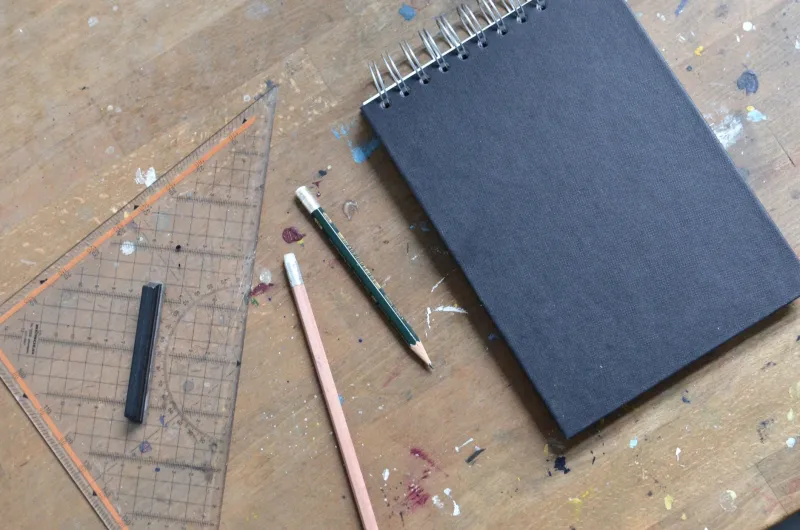
Museums show you the armor. The finished painting, the printed page, the final cut — all of it polished, all of it curated, all of it the artist as they wanted to be seen. But the notebooks? The notebooks are where the artist talks to themselves at 2 a.m., and they don't perform for themselves.
That's why the private pages of great creators have become a genre of fascination all their own. Not out of voyeurism, exactly. Out of a suspicion — increasingly hard to deny — that the rough work is the real biography.
Where the Ideas Actually Come From
Consider Leonardo da Vinci, whose surviving notebooks run to thousands of pages of mirror-script observations, grocery lists, anatomy studies, and grotesque face doodles. The paintings are a handful. The notebooks are a mind. You can watch him worry a problem — water flow, horse anatomy, a smile — across dozens of pages, and the worry itself is the work.
Or look at the sketchbooks of the great American illustrators. Normal Rockwell's reference photos and thumbnail studies reveal an artist far looser and stranger than his finished covers suggest — the corniness was a choice, a translation. The private Rockwell drew gangly, expressive, almost cartoonish figures that would scandalize anyone who only knew the Saturday Evening Post.
Comic artists might be the most revealing of all, because their finished work is already drawing. Jack Kirby's margins are full of the same faces, the same fists, the same cosmic energy — but also self-portraits, jokes, complaints about editors. Charles Schulz's early sketches show a loneliness that Peanuts would eventually dress in wit.
The Breakthroughs Hide in the Rough Pages
Here's the pattern that keeps recurring: the big leap almost never appears fully formed in the finished work's predecessor. It appears as a fragment, a rejected experiment, a doodle the artist didn't even bother to keep — until someone found it later and connected the dots.
Picasso's studies for Les Demoiselles d'Avignon are more radical than the painting itself; the canvases he abandoned scared even him. Filmmakers' storyboards routinely contain shots more daring than anything that survived the budget. The rough work is where artists try on versions of themselves the finished work can't afford to be.
Why We Can't Look Away
Part of the appeal is simple: we want to know if the magic was magic. And the notebooks answer, in a way that's strangely comforting — no, it wasn't magic. It was volume. Da Vinci drew the same hands hundreds of times. The greats filled page after page with failures we never see, and the published work is just the residue of all that failure.
That's a more useful myth-busting than any motivational poster. The gap between the sketchbook and the masterpiece isn't talent. It's tolerance — for bad pages, for repetition, for ideas that go nowhere.
Process Is the Purest Story
There's also a narrative argument. A finished painting is a conclusion; a sketchbook is a plot. It has false starts, reversals, obsessions that resurface decades later. Read a great artist's notebooks in order and you get something no retrospective can give you: the story of a person changing, in real time, one bad drawing at a time.
That's why so many museums now exhibit the drafts alongside the finals — the MoMAs and the Library of Congresses of the world have figured out that audiences don't just want the answer. They want the thinking.
The finished work tells you what the artist believed. The sketchbook tells you what they were figuring out. And figuring out, it turns out, is the most honest thing a person can put on paper.